
Role-based access controls
Separate admin and driver sessions protect operational access by user role, with guarded portals and permission-checked routes.
RapidMed supports delivery records, proof capture, role-based access, secure intake, and audit logs for pharmacy delivery operations.
Separate admin and driver sessions protect operational access by user role, with guarded portals and permission-checked routes.
Timestamped delivery timelines store intake, dispatch, and status events for later review.
Photo capture and signature steps support stronger verification when completed deliveries need review.
Pharmacy document intake uses token-validated upload links with file-type checks and rate limits for cleaner documentation readiness.
Proof retrieval flows include explicit access logging and role restrictions for sensitive delivery confirmation review.
Driver location updates support dispatch review for active deliveries and escalations.
Formal questions around hosting architecture, transport encryption enforcement, broader data-at-rest controls, retention schedules, and infrastructure ownership should be answered against the production deployment, not implied by marketing copy alone.
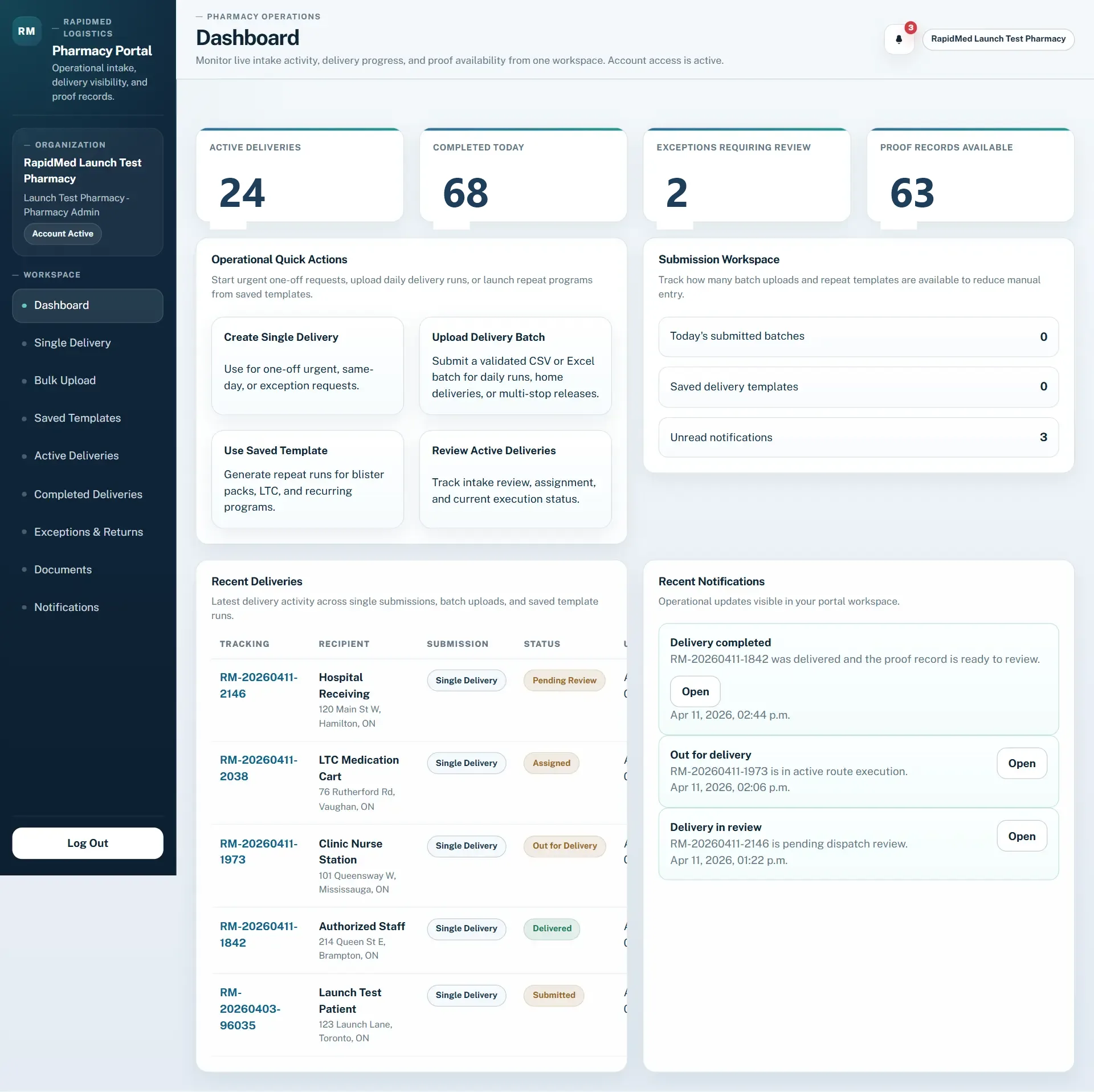
Healthcare buyers need clear delivery records, not broad system claims. These are the core records and control points RapidMed can discuss.
Where the request came from, who entered it, what documentation was attached, and when the delivery entered review.
Signatures, timestamps, verification photos where required, and delivery events that support follow-up.
Controlled proof retrieval, access logging, and exception notes that remain connected to the delivery history.